







Decision Makers 2010
Building Sustainability in a Globalized World
Conference
June 7-10, 2000, Hong Kong
Executive Summary
Program & Real Audio Presentations
Participants
Picture Gallery
Art Gallery
Word-Download: Executive Summary in German
|
|
|
|
|
|
|
|
|
|
||
|
|
|
|
||
|
|
|
Decision Makers 2010 Building Sustainability in a Globalized World Conference June 7-10, 2000, Hong Kong Executive Summary Program & Real Audio Presentations Participants Picture Gallery Art Gallery Word-Download: Executive Summary in German |
||
|
|
|
|
||
|
    |
 |
|
Building Sustainability in a Globalized World Hong Kong`s Sustainable Future C.Y. Leung, 8 June 2000 Ladies and Gentlemen, 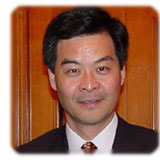 Hong
Kong is no longer the so-called "Borrowed place on borrowed time". Hong
Kong did not expire on 30th June 1997. Since late 1996, Hong Kong people
have in their minds a much broader time horizon. The future of the Hong
Kong people is no longer defined in terms of Canadian housing prices,
Australien education system or US retirement schemes. Within this broader
time horizon are two things. First, all the long-range issues. Secondly,
a new sence of belonging, in other words, new energy that is being harnessed
to tackle these long-range issues. Hong
Kong is no longer the so-called "Borrowed place on borrowed time". Hong
Kong did not expire on 30th June 1997. Since late 1996, Hong Kong people
have in their minds a much broader time horizon. The future of the Hong
Kong people is no longer defined in terms of Canadian housing prices,
Australien education system or US retirement schemes. Within this broader
time horizon are two things. First, all the long-range issues. Secondly,
a new sence of belonging, in other words, new energy that is being harnessed
to tackle these long-range issues.One of the long-range issues that Hong Kong has focussed on is sustainability. The need to ensure Hong Kong´s long-term sustainability is obvious. Hong Kong has a small land mass. Total land area in Hong Kong is a little more than 1,000 square kilometres. Only 5% of this area is developed. The undeveloped parts of Hong Kong are mostly undevelopable, either because of the difficult terrain or the need to preserve the natural environment. 38% of the total land area of Hong Kong is designated country parks. The typical scene shown on Hong Kong`s postcards is the city skyline, with some of the tallest buildings in the world. Unknown to most people overseas is the huge area of unspoilt countryside. Even less well known is the fact that Hong Kong is home to a great vwariety of flora and fauna. For example, Hong Kong is the natural habitat of more species of butterflies than the number of species in the whole of the United Kingdom. A proposed development in Sha Tung which is the habitat of a unique specie of dragonfly is the subject of debates for more than ten years. Last year, Government rejected the devel application. At the same time, Hong Kong´s population has been increasing at very high rates. In the last seven years, total population increased by 16%, from 6 to 7 million. Natural increase accounts for about 15% of the total increase. Immigration accounts for 85%. Half of the immigration is from the mainland of China, the other half from overseas, including a fair number of people returning from emigration. Given these constraints, it is not difficult to appreciate the stresses that have been put on the environment. However over the years , by a combination of market forces and government policies, Hong Kong has been able to effectively strike a belance between growth and sustainability. Hong Kong has been able to use ist resources more effectively. We have moved most of our industrial processes to the mainland, since China launched ist reforms some 20 years ago. There is less competing demand for land for industrial use. There is less industrial pressure on the environment. Only 10% of the working population work in the manufactoring sector, and mostly in white-collar positions. Most of our industrial buildings are now being used for non-manufacturing purposes, such as design, qualiy control, administration and marketing functions. Another result of the massive relocation of manufacturing activities is the reduced use of water and energy, including petroleum products and electricity. We have also been able to tackle pollution of the water courses and the sea. Farming activities that pollute water courses have either been controlled or removed. Sewage treatment and disposal is the subjact of a massive engineering and funding program. Left on the "to-do" list is air pollution. This subject is now on the top of Government´s agenda. Air pollution is now almost entirely a result of vehicle mevements. The battle against air-pollution is therefore being fought om two fronts. One is the reduction on the toxic contents of vehicle emissions and then the reduction of irritants in the emissions. The other battle is to reduce the reliance on the internal combustion engine. The most acute air pollution problem at street level. In the six years ended 1997, the number of vehicles licensed in Hong Kong increased by some 30% and the vehicle-kilometre-travelled by 25 %. New road projects have generally caught up with the growth of vehicles. But in the inner-city areas, the widths and lengths of roads cannot be expanded. Black-spots have therefor appeared in certain parts of Hong Kong vehicles run on diesel, compared with 17% in Singapore., 10% in the UK and 4% in the USA. Our diesel vehicles account for about 70% of all kilometres travelled each year. Hongkong-wide, particulates increased by 10% between 1991 and 1997, Nox by 13% and VOC( Volatile Organic Compounds ) By 18%. Annual averaged concentrations of RSP (Respiratory Suspended Particles) remain high. The first and a key response from Government is the formulation of policy framework, with clear objectives and priority targets. The Hong Kong Government also provides the necessary infrastructure. Infrastructures ranges from small projects such as LPG filling stations for taxis to ambitious railway projects. In addition, the Hong Kong Government also provides economic incentives, as it has for LPG taxis, to achieve environmental objectives. From the end of 2000, it will be mandatory for new taxis to run on LPG. Despite their small numbers, taxis account for more than one-third of vehicle-kilometre-travelled amongst all diesel-run vehicles. The mandatory conversion of taxis into LPG from the end of 2000 should make a notable impact on the level of pollution from this source. Franchised bus companies have agreed to install diesel catalysts on some 2,000 buses that do not meet the latest Euro II emission standarts. These can reduce emission from individual vehicles by up to 50%. Toxic emissions have been substantially reduced. SO2 concentrations fell by up to 80 % in industrial areas, as a result of the ban on high sulphur fuels since 1990. The use of natural gas for power generation and coal units built after 1991 with flue gas desulphurisation system has also reduced SO2 emissions by 60% in the 6 years ended 1997. The construction dust regulation introduced in 1997 has reduced dust emission from individual construction activities by up to 80%. The phasing in of unleaded-petrol since 1991 and the complete ban on leaded-petrol since April 1999 means that there is virtually no lead emissions from petrol vehicles. Three weeks ago, following on the Chief executive´s Policy Address in October last year, Government announced another package of measures. Taxi drivers will be given a $40,000 grant to buy an LPG-powered taxi. Because of the low pump price of LPG, they will also save about $35,000 a year in running costs. Government will also seek approval from the Legislative Council for $50 million o proide particulate traps for all pre-Euro light diesel vehicles. All Government diesel vehicles will use ultra-low sulphur diesel (ULSD), which reduces particulate emissions by 10-30 per cent per vehicle. It is expected that UlSD will be readily available by the end of the year. Franchised bus companies will be asked to use ULSD. Hong Kong will be less reliant on the international combustion engine. Today, the Mass Transit Railway System carries one million passengers a day. The Kowloon Canton Railway 750,000 passengers a day. In addition, five new railways are being built, costing nearly US$20 billion. Last month, Hong Kong Government announced another massive railway development program that takes Hong Kong into the year 2016. These railways will provide pollution-free transportation. More importantly they will open up the New Territories and Guandog to relieve stresses on Hong Kong´s environment. There is no room for complcency in tackling environmental problem. At the same time, we should recognize that some of the earlier efforts are beginning to bring discernable results. The number of days of poor visibility due to air pollution has fallen from the peak level of 1997 and is even below that of 1996. Hong Kong has overcome bigger challenges in the past. There were bigger headlines in the past about Hong Kong´s other challenges, such as the transition to 1997, in overseas newspapers. We have pulled through and prospered,. Now that Hong Kong has put the question of sustainability on ist agenda, I am sure Hong Kong will continue to be a city of witch we can be proud. The Hong Kong Government issued a consultation document in October 1999 for the second stage consultation for "Sustainable Development in Hong Kong for the 21st Century" (SUSDEV21 for short). Based on public viewes collected in the first stage consulation in1998, our consulant has come up with a definition and a set of indicators for measuring and implementing sustainable development. Sustainable development can mean different things to different people and there is no consenus on a universally applicable definition. In the consultative document, our consultant comes up with a definition that spells out the essential aims of sustainability. The definition reads: "Sustainable development in Hong Kong balances social, economic and enviromental needs, both for present and future generations, simultaneously achieving a vibrant economy, social progress and better enviromental quality, locally, nationally and internationally, through the efforts of the comnunity and the Government" The definition covers the essential aims of sustainability, that of protecting and enhancing economic, enviromental and social assets for both present and future generations. On this, the Chief Executive has clearly laid down the policy objectives for sustainable development in his Policy Adress 1999:
Sustainable development in Hong Kong is not just about developing a sustainable environment but also the development of the spirit of sustainable development and planning ahead for the future. That Spirit grows from our concern for our next generation and the action we takeeto plan for their future. The reward of achieving sustainable targets is tremendous. Ours is a city that provides open countryside in close proximity to high-density urban areas. Compact, convenient, exciting and efficient urban living is available at a short distance from the rural scencic beauty. Ours is also a city that is home to people from many different parts of the world. Our door is as open as any door can ever be. This city also has a long coast line, with a body of deep water close to everyone´s homes offices. A sustainable Hong Kong will unlock many of these treasure troves. A sustainable Hong Kong is not only a better Hong Kong to live in, it is also a better Hong Kong to do business in. With these words, I would like to welcome you again to our city. I hope you will enjoy your stay in Hong Kong. I also trust that your conference will be fruitful. Back to Executive Summary | Program |
|
|
|
||||
|
Project Background | Events | Reports and Essays Zukunftszeugen | Contact Us | Home Page Last Modified: 2002-04-23 TOP |
||||